Missed the R&D Tax Credit Amendment Deadline? Here’s What You Can Still Do
In Brief:
- The deadline was July 6, but amendments are still possible. Businesses can amend 2022–2024 returns to claim the R&D credit but must apply the old five-year amortization rules for those years.
- The statute of limitations varies. Federal amendments generally go back three years (four in some states like California), with the window tied to your original filing date.
- Protective elections matter. Without a filed Section 280C election on the original return, the credit must be added back to taxable income, which could trigger a tax bill before any refund arrives.
- 174 expensing options for 2025–2026. Taxpayers can accelerate remaining unamortized R&D costs fully in 2025, split them across 2025–2026, or keep the existing amortization schedule.
- Talk to your JLK Rosenberger advisor. Entity type, business goals, documentation quality, and potential state tax implications all affect whether amending makes sense for your situation.
The One Big Beautiful Bill Act signed into law in 2025, calls for 60 major tax changes affecting both businesses and organizations. One of the most notable was the permanent reinstatement of immediate expensing for eligible research and development (R&D) expenses. To capture the benefit, small businesses could retroactively amend returns from 2022-2024, while large companies can deduct remaining unamortized expenses in 2025 or split between 2025 and 2026. The deadline for small businesses to amend returns passed on July 6th, leaving many wondering if they can still benefit. To help clients, prospects, and others, JLK Rosenberger has summarized the key options below.
Can I still amend to claim the R&D tax credit?
Yes, but the amendments would need to factor in the old amortization rules, which require domestic research expenditures to be capitalized and amortized for five years if the amended tax years are 2022, 2023, or 2024.
A company may amend up to three years prior for federal credits. Some states, like California, allow you to go back four years. The cutoff depends on when you filed the tax return. If you extended it, the statute of limitations begins on the date your return was submitted. If it is timely, regardless of whether you filed before the deadline, you get the benefit of the timely file deadline, which for calendar-year companies is 03/15 or 04/15 depending on your entity type.
Can I claim the reduced credit or make a 280c election on an amended tax return?
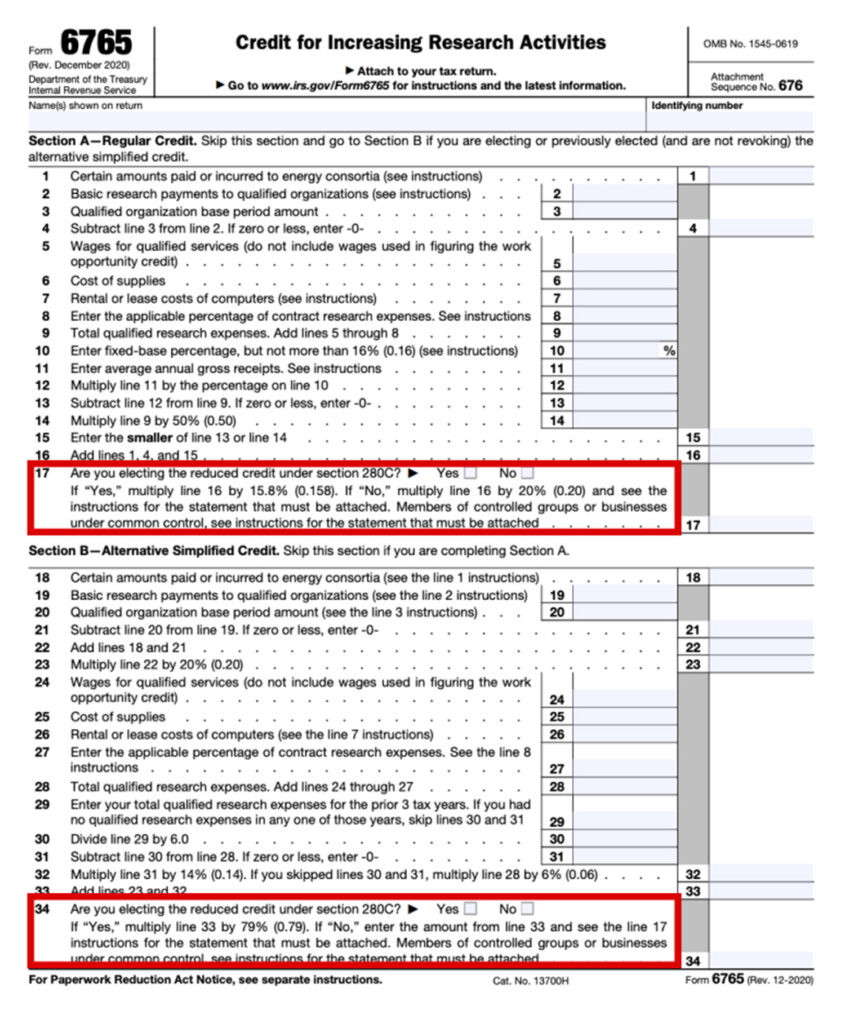
It depends on whether you filed “protective elections” on your original tax return for that year. If you open your tax return and search for Form 6765 and one is not included, then no, the credit will need to be added back into taxable income. This could mean that in some instances, you may owe money in a year before receiving a refund.
Before 2024, the protective election, if filed with your original return, looked like the image below. You only need to check one of the 280c election boxes; either is fine. Nowadays, it no longer locks you into the credit methodology selected.
For tax year 2024, the form changed, and it is now included at the top of Form 6765, as shown in the image below.
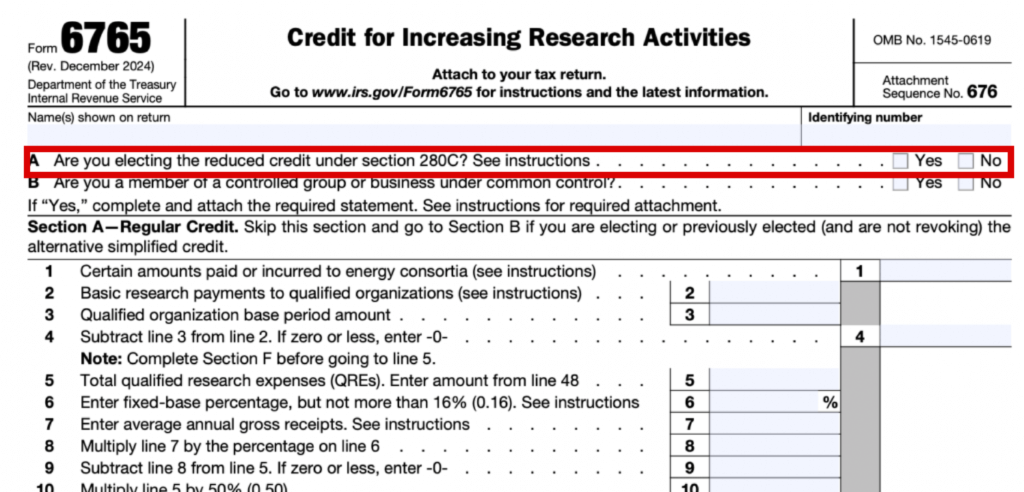
If you think you may want to amend your tax return to claim R&D, let your CPA know. The benefit is generally a lower tax rate of 21% and less effort to add the credit amount back into taxable income.
If I choose to amend, what are my options for recapturing 174 amortized expenses?
All taxpayers that capitalized research expenses, regardless of size, still have the option of:
- Accelerating the remaining unamortized amounts fully in 2025.
- Accelerating the remaining unamortized amounts equally across 2025 and 2026.
- Keeping the amortization schedule as is.
What if I am in NOLs and cannot use the credit in an amended tax year? Should I still claim it?
Whether it makes sense depends on your specific tax situation and when you generate enough taxable income to offset the credit.
Special rules apply to NOLs and the R&D tax credit. If there is a closed year outside of the three-year statute of limitations where you were in NOLs, you can claim the credit for that year and carry it forward for use in future years. One catch is that, as you carry the amount forward, regardless of whether you claimed the credit for those years or not, you must reduce it by the amount that could have been used.
Can I use the R&D Tax Credits to offset all of my taxable income?
No, there are limitations, and you cannot use R&D tax credits to offset all tax owed completely. There is a minimal threshold of tax that you are still required to pay. On the federal level, any unused credits can be carried back one year and forward up to 20 years.
Do I still need to track my 174 expenditures?
The answer is yes. It can be highly beneficial because, starting in 2025, you can deduct the full amount in the year the expense is incurred. Many costs can be included as a research and experimental expense – employee wages, overhead, patent costs, travel, certain indirect costs, contracted research where you fund it or own rights to the research, supplies, materials – to name a few.
What other things should I consider before amending my tax return?
- Where you are in your business? Start-up companies may be eligible for up to five years to use the credits to offset payroll tax.
- What are your future goals? Are you changing entity types, planning to sell your company, or anticipating any ownership changes? These things can affect your credit benefit. Typically, for pass-through entities, the credits stay with the owners and partners, whereas with corporations, the credits stay with the company.
- How is your documentation tracking for those years? And three years prior, which is generally required for the calculations.
- You may owe money before receiving your refunds if the credit gets added back into taxable income and there may be state tax implications.
- The cost of R&D services and amending tax returns.
We’re Here to Help
Now that the July 6th deadline has passed, businesses can still amend their 2022-2024 corporate tax returns, but they must follow special rules. Because of the significant tax implications, consult a qualified tax advisor to determine the best steps for your company. Most importantly, consider the true benefit after taxes and fees, and the timing of when you would receive a refund. If you have questions about the information outlined above or need assistance with another R&D issue, JLK Rosenberger can help. For additional information, call 949-860-9902, or click here to contact us. We look forward to speaking with you soon.